
Can a Laser Welding Machine Weld High-Hardness Metals?
Yes, a laser welding machine can weld high-hardness metals—but success depends heavily on material type, heat control, and process design. It’s not as simple as turning on the laser and expecting a crack-free joint.
Why High-Hardness Metals Are Challenging
Materials like tool steel (e.g., H13), martensitic stainless steels (e.g., 410, 420), or nickel-based superalloys often have high carbon or alloy content. When heated and cooled rapidly—as in conventional welding—they form brittle martensite, leading to cold cracks or reduced toughness. Traditional arc methods usually require preheating and post-weld heat treatment to mitigate this.
How Laser Welding Helps
The key advantage of a laser welding machine is its ability to deliver precise, concentrated heat with minimal thermal input. With a small heat-affected zone (HAZ) and fast cooling rates, you reduce distortion and limit unwanted phase transformations—if the parameters are tuned correctly.
For example, H13 tool steel (48–52 HRC) can be successfully welded using a fiber laser with controlled power ramping, low heat input, and sometimes minimal preheat (150–250°C). In many cases, only a light stress-relief temper is needed afterward, not full re-hardening.
Critical Factors for Success
Power density and pulse shaping: Continuous wave isn’t always best. Pulsed or quasi-continuous modes allow better control over peak temperature.
Shielding gas: High-purity argon or helium mixtures help prevent oxidation and hydrogen pickup.
Joint fit-up: Gaps larger than 0.1 mm increase crack risk due to uneven melting.
Post-weld handling: Even with laser precision, some high-strength alloys still benefit from controlled cooling or tempering.
Bottom Line
A laser welding machine doesn’t magically eliminate cracking in hard metals—but it gives you far more control than traditional methods. With the right setup, many high-hardness components can be welded reliably, often with less pre/post-treatment. Always validate with actual material samples before committing to production.
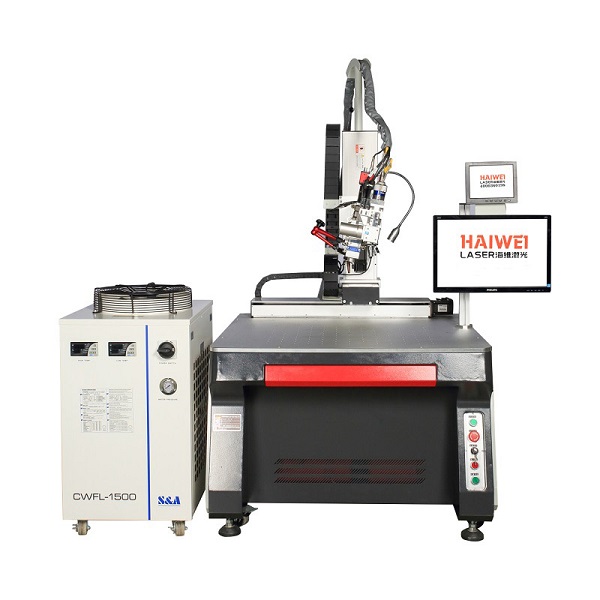
For reliable welding of high-hardness metals, Haiwei Laser’s systems offer precise power control, advanced pulse shaping, and proven process stability—helping manufacturers achieve consistent, low-crack results with minimal post-weld treatment.
Recent Posts
- What are the advantages of laser welding machines in lithium battery pack production lines?
- What issues should be noted when choosing a lithium battery pack production line?
- Quality Inspection and Control of Lithium Battery Module Pack Production Line
- Cell grouping and sorting process in lithium battery module pack production line
- What are the safety hazards of lithium battery pack production lines and how can they be prevented?
INQUIRY